Introduction
The 26th International Workshop on Clinical Pharmacology of HIV, Hepatitis, and Other Antiviral Drugs took place in September 2025, in Amsterdam, the Netherlands.1 This international meeting, dedicated to the pharmacology of antiretroviral and antiviral therapies, is a venue for researchers and clinicians to learn about the latest scientific advances in this field and was attended by more than 120 in-person and virtual delegates. This article highlights selected presentations and abstracts from the Workshop, with insights to assist clinicians in applying new data to clinical practice. Enduring materials are available at the conference website.2
Considerations for HIV Prevention
Postexposure Prophylaxis
Two plenary sessions focused on pharmacologic considerations and challenges with strategies for HIV prevention with postexposure prophylaxis (PEP). Von Kleist presented modeling data3 that helped inform the updated HIV PEP Guidelines from the World Health Organization (WHO).4 The model suggested that 2-drug PEP with tenofovir disoproxil fumarate (TDF)/emtricitabine (FTC) offers insufficient protection if initiated more than 1 hour after sexual exposure, whereas 3-drug PEP is more effective when initiated within 48 hours of exposure and taken for 28 days. Simulations also suggested that if only TDF/FTC was immediately available, starting this as soon as possible and adding a third agent such as dolutegravir (DTG) within a week, and taken for 28 days from the first TDF/FTC dose, may prevent acquisition. In the second plenary, Taylor noted that real-world scenarios may be complex and require the application of pharmacologic principles combined with a pragmatic approach for optimal implementation and patient acceptance.
Preexposure Prophylaxis
Long-acting lenacapavir (LEN) subcutaneous injection for preexposure prophylaxis (PrEP) is approved in the US5 and European Union,6 and is endorsed by the WHO as an HIV prevention option.7 However, equitable global rollout, including in low- and middle-income countries, is imperative. Target LEN concentrations are achieved on day 1 when subcutaneous administration is initiated with oral lead-in dosing on day 1 and day 2. In the absence of oral LEN loading, target concentrations are not achieved for 35 to 42 days based on initial pharmacokinetic (PK) data in participants without HIV. The need for generic manufacturers to develop and gain approval for injectable and oral formulations of LEN is a potential logistic and fiscal barrier. Owen presented modeling data8 suggesting that low-cost oral daily PrEP (eg, generic TDF/FTC or tenofovir alafenamide [TAF]/FTC) could be an alternative to oral LEN lead-in as a bridging strategy for up to 42 days to ensure effective protection until subcutaneous LEN reaches protective concentrations.
Developmental Drugs for HIV Treatment
VH4524184 (VH-184) is a third-generation integrase strand transfer inhibitor (InSTl) with potent activity, long-acting potential, and an improved in vitro resistance profile relative to second-generation InSTIs. Collins presented results from a drug-drug interaction (DDI) study in female participants showing no relevant interaction between VH-184 and combined oral contraceptives.9
ACC017 is a novel InSTI with potent activity, an in vitro resistance profile that differs from other InSTIs, and favorable preclinical safety and PK properties. Qin presented results from a placebo-controlled, dose-ranging, short-term monotherapy study that showed potent antiviral activity,10 with PK properties supporting once-daily dosing.11 Administration with a high-fat standard breakfast (typically defined as 800-1000 kcal and ≥50% fat) modestly increased ACC017 exposure but is not anticipated to impact safety.12
Children and Adolescents
Therapeutic Drug Monitoring
Pilote reported on a cohort of 53 pediatric patients where 249 DTG therapeutic drug monitoring (TDM) samples were obtained, with an average of 8.6 samples per person.13 The mean age and weight were 11.1 years and 18.8 kg, respectively, and 86% had viral suppression. More than half (55%) of DTG trough concentrations (Ctau) were supratherapeutic (≥1.47 mg/L), 21% were therapeutic, and 4.8% were subtherapeutic (<0.32 mg/L), with high interindividual variability (coefficient of variation [CV], 65.4%) and lower intraindividual variability (25.6%). All Ctau values in children weighing more than 6 and less than 14 kg were supratherapeutic, and 64% of Ctau values were supratherapeutic in children weighing more than 30 and less than 40 kg. Supratherapeutic concentrations were not associated with bothersome central nervous system effects, and no dose reductions were implemented. No significant difference in mean Ctau was found in patients with and without viral suppression. These results confirm the large interindividual variability of DTG in children and adolescents, and are consistent with other data that indicate a lack of relationship between DTG exposure and virologic response in children.14 As such, routine TDM is not indicated in pediatric care.15 The Quebec Antiretroviral TDM Guidelines16 moderately recommend (B-II) TDM for children taking the dispersible tablet formulation of DTG due to higher variability in bioavailability, but otherwise do not recommend DTG TDM for pediatric patients.17
Novel Matrices for Drug Concentration Measurement
In contrast to plasma concentrations, intracellular antiretroviral concentrations are not as impacted by factors influencing absorption, food intake, metabolism, or drug interactions, and thus represent a more consistent marker of drug exposure. Tenofovir-diphosphate (TFV-DP) in dried blood spot (DBS) testing has been used to provide insight into long-term adherence and PrEP efficacy. In contrast, limited data exist regarding the intracellular pharmacology of abacavir (ABC) and lamivudine (3TC) in children. Schwab presented results from IMPAACT 2019 (Pharmacokinetics, Safety, and Tolerability of Dispersible and Immediate-Release Abacavir, Dolutegravir, and Lamivudine Tablets in Children With HIV), where 55 children received fixed-dose combinations of ABC/DTG/3TC across 5 weight bands.18 Intracellular concentrations of carbovir-triphosphate (TP) and 3TC-TP were measured using DBS tests and peripheral blood mononuclear cells and were found to be quantifiable and generally consistent across study visits and weight bands. These results support evaluating the utility of DBS testing in future pediatric studies to explore factors influencing intracellular concentrations and relationships with adherence, potentially providing a more child-friendly way of monitoring treatment.
Breastmilk Transfer of Bictegravir
Bictegravir (BIC)/TAF/FTC was recently included in the US Perinatal Treatment Guidelines as a preferred regimen for antiretroviral-naive pregnant individuals.19 Van Der Wekken-Pas presented the first study to describe human breastmilk concentrations in 12 healthy volunteers following a single dose of BIC.20 Similar to DTG, they found low concentration of BIC in breastmilk, with a breastmilk-to-plasma ratio of 0.01. The relative infant dose was minimal (<1%) and not expected to present any safety concerns in the infant. Because breastmilk transfer is not expected to be substantially different based on HIV status, or during continuous use compared with a single dose, these data provide reassuring safety information for virologically suppressed individuals on BIC who breastfeed.
Drug-Drug Interactions
Although modern antiretroviral drugs have a lower potential for DDIs, the management of DDIs with rifamycins or other moderate or strong inducers remains a major clinical challenge due to the risk of antiretroviral treatment failure. One session addressed various questions related to DDIs with rifamycins, including strategies for dosing adjustment of the novel capsid inhibitor, LEN, and the inducing effect of high-dose rifampicin.
Lenacapavir
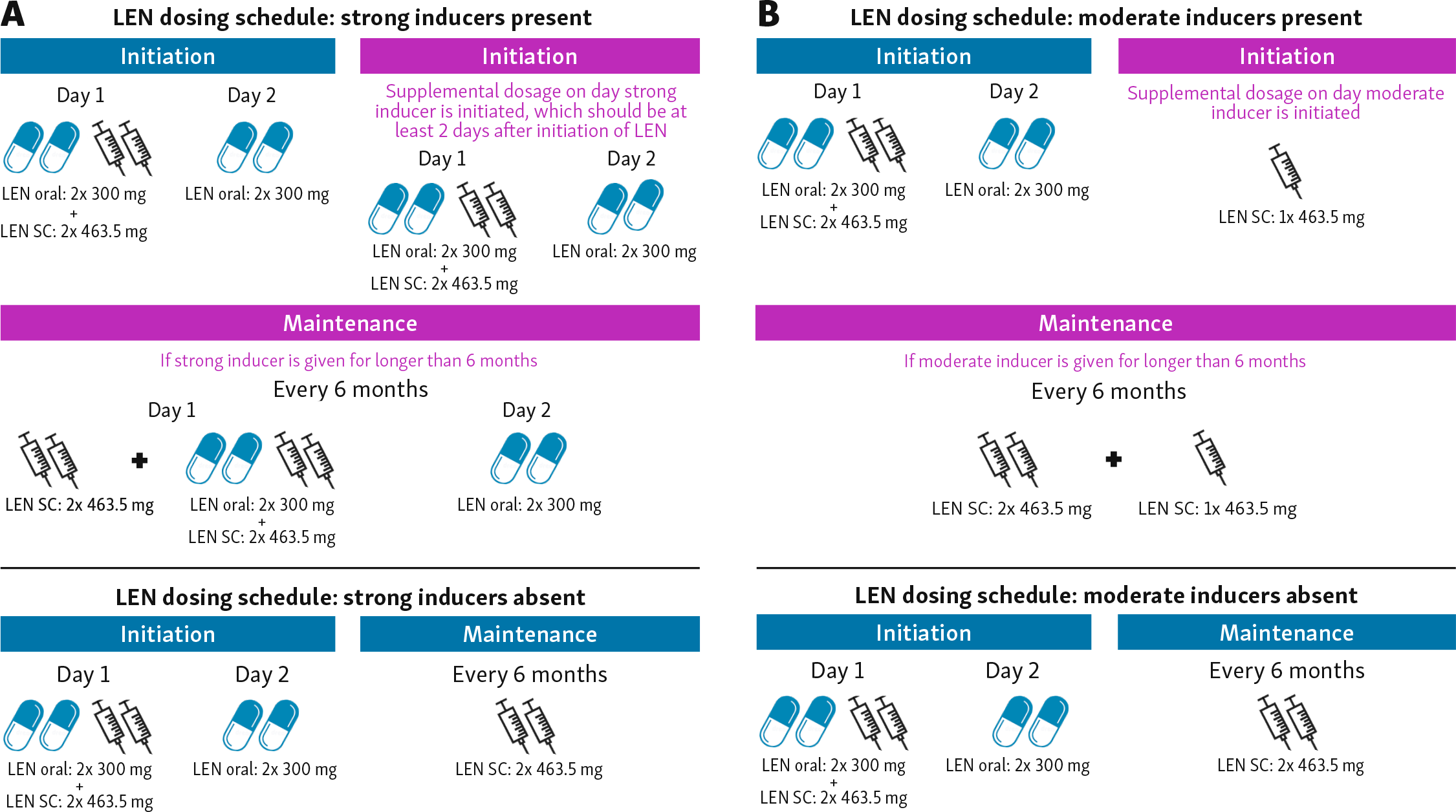
Salerno presented a whole-body physiologically based (PB) PK model to simulate dosing recommendations for subcutaneous LEN used as PrEP when administered concurrently with rifampicin or rifabutin.21 The model suggested that the strong inducing effect of rifampicin may be mitigated by administering a supplemental dose of 927 mg subcutaneous LEN plus 600 mg oral LEN on the day rifampicin is initiated, followed by an additional 600 mg oral LEN dose the next day. In other words, the recommendations are to administer a double dose of subcutaneous LEN plus a double dose of oral LEN (Figure A). Supplemental oral and subcutaneous dosing is continued every 6 months in addition to the standard LEN maintenance dosing schedule. Strong inducers may be started at least 2 days after LEN (subcutaneous plus oral lead-in) is initiated. The DDI with rifabutin may be overcome with a supplemental 463.5 mg subcutaneous dose of LEN on the day rifabutin is started and continued every 6 months in addition to the standard every-6-month subcutaneous maintenance dosing schedule (Figure B). Moderate inducers, such as rifabutin, may be started any time after LEN is initiated.
Based on this physiologically based PK model, the US Food and Drug Administration (FDA)-approved prescribing information for LEN used for PrEP allows concomitant use with strong and moderate inducers, provided supplemental LEN doses are given to individuals already receiving LEN.5 However, dosing recommendations are not available for a scenario in which someone is already on a chronic inducer and needs to initiate LEN. Importantly, in the US FDA prescribing information for LEN as treatment, use with strong and moderate inducers remains contraindicated.
In contrast to the FDA LEN PrEP prescribing information, the European LEN prescribing information for its use as PrEP contraindicates the use of LEN with inducers, regardless of the clinical scenario considered.6 Due to the lack of data on parenteral interaction potential (ie, the DDI study with oral LEN plus rifampicin was used to predict the DDI potential with subcutaneous LEN), the European Medicines Agency concluded that the physiologically based PK model presented at the Workshop and submitted with regulatory filing documents relied on untestable assumptions and was, therefore, not considered adequate. Consequently, given this uncertainty and the absence of real-world data, alternative PrEP options could be considered for individuals requiring concurrent treatment with strong or moderate cytochrome P450 (CYP)-3A4 inducers.
Dose-Effect of Rifampicin on DDIs
High-dose rifampicin has been associated with more rapid lung sterilization and may enable shorter tuberculosis (TB) treatment regimens. However, the impact of high-dose rifampicin on the induction of drug-metabolizing enzymes has not been fully evaluated. Dickinson presented a 4-phase study in which individuals with TB receiving DTG 50 mg twice daily were sequentially administered rifampicin at increasing doses of 10 mg/kg, 20 mg/kg, and 35 mg/kg, followed by DTG 50 mg once daily alone, 4 weeks after completing TB treatment.22 The inducing effect of rifampicin on CYP-3A4 and P-glycoprotein was assessed using single doses of midazolam and digoxin on PK sampling days. DTG, midazolam, and digoxin exposures showed minimal change with increasing rifampicin doses compared with the standard dose, suggesting that maximal CYP-3A4 and P-glycoprotein induction is achieved at 10 mg/kg and that no additional DTG dose adjustment is necessary with high-dose rifampicin.
DDIs in Specific Populations
In addition to a plenary given by Cirrincione on the overall effect of hormones on pharmacology, a DDI study examined the effect of gender-affirming hormone therapy, including estradiol, spironolactone, or cyproterone, on the PK of BIC/TAF/FTC in transgender women compared with cisgender women. Sunagawa reported no substantial differences in antiretroviral drug exposure between the 2 groups, providing reassurance that gender-affirming hormone therapy and antiretroviral therapy can be safely coprescribed.23
Access to modern antiretroviral drugs with reduced potential for DDIs has coincided with an aging population with HIV presenting with more comorbidities and polypharmacy. Le analyzed more than 7 million DDI queries from 48 countries submitted to the Liverpool HIV Drug Interaction database24 and observed a 441% increase in the number of queries between 2020 and 2024.25 Conversely, a reduction in the overall severity of DDIs was noted in recent years, likely reflecting the broader use of contemporary antiretroviral therapies with more favorable DDI profiles. The most frequently searched antiretroviral therapies were DTG and BIC, and the top-searched comedication classes included lipid-lowering drugs, cardiovascular drugs, herbal products/supplements/vitamins, and gastrointestinal agents. Despite the shift toward unboosted antiretroviral regimens, DDIs remain an ongoing concern due to the aging HIV population.
Is Artificial Intelligence Ready for DDIs?
To explore novel tools for DDI management, Ready evaluated the ability of artificial intelligence (AI) using the large language model ChatGPT to accurately identify and provide guidance on antiretroviral DDIs.26ChatGPT demonstrated limited accuracy (<50%) in detecting, classifying, and providing correct guidance on DDIs compared with trusted HIV DDI resources (ie, the HIV/HCV Drug Therapy Guide and the HIV Drug Interactions database).24,27 Notably, ChatGPT tended to generate unfounded warnings about nonexistent or clinically insignificant DDIs. For example, ChatGPT warned that darunavir/cobicistat could increase bupropion exposure, thereby increasing the risk of seizure, which is incorrect. ChatGPT also underestimated the severity of serious DDIs. For example, ChatGPT did not warn about the potential risk of doravirine treatment failure when combined with the potent inducer enzalutamide. Thus, ChatGPT is not yet a reliable AI tool for antiretroviral DDI information, although its performance may improve as the technology evolves.
Cabotegravir and Rilpivirine Pharmacokinetics
Several abstracts focused on understanding the pharmacokinetics of long-acting cabotegravir (CAB)/rilpivirine (RPV) in unique matrices, in adolescents, and on steady-state concentrations after more than 1 year of ongoing use.
Unique Matrices
Rosen described a novel method to evaluate variation in drug exposure using penetration of long-acting injectable CAB/RPV into hair strands.28 Using 5 plucked hair strands from 18 people with HIV (6 female, 11 male, 1 nonbinary; 7 White, 9 African American, 1 other, 1 information unavailable), they measured antiretroviral drug levels in hair over time using infrared matrix-assisted laser desorption electrospray ionization (IR-MALDESI) mass spectrometry imaging. Intraindividual variability was higher in strands for those who received CAB and RPV than in those who received oral dosing of FTC, with CAB variability reaching statistical significance (P<.05). This method offers a potential noninvasive means of assessing short- and long-term exposure, which may support patient monitoring to identify those with low drug exposure who may be at risk for virologic failure.
Neverette presented time-matched blood plasma and seminal plasma concentrations of long-acting CAB/RPV measured longitudinally over a 2-mo nth dosing interval.29 In seminal plasma, they found that total CAB and RPV concentrations were 10% or lower than those in blood plasma. However, because protein binding in the seminal plasma is substantially lower, they found more than 3-fold higher unbound CAB and RPV concentrations in seminal plasma than in blood plasma. These data align with recently presented findings of total and unbound trough concentrations in blood and seminal plasma,30 and reaffirm that exposure remains above the desired effective concentration in the male genital tract.
Data in Adolescents
Bevers presented data on the PK properties of long-acting CAB/RPV from the LATA (Long-Acting Treatment in Adolescents) trial in adolescents in sub-Saharan Africa.31 The LATA trial recruited adolescents who had virologic suppression for at least 1 year and a PK substudy was conducted in the long-acting CAB/RPV arm. PK sampling occurred after the second maintenance dose of long-acting CAB/RPV at week 24 in participants with a median age of 17.4 years (range, 12.7-20.4 years). As in other studies and real-world evaluations, there was high variability in PK properties, and there were no substantial differences in the PK data observed in LATA participants compared with adult clinical trial PK data.
Variability in Exposure
Sunagawa presented Ctau concentrations at 3 consecutive visits in 47 participants receiving long-acting CAB/RPV every 8 weeks for a median of 65 weeks.32 High interindividual variability was observed for CAB and for RPV, and intraindividual variability was low for CAB and moderate for RPV. There were 20 RPV (14%) and 10 CAB concentrations (7%) that fell below the proposed efficacy threshold (<4x protein-adjusted 90% inhibitory concentration [IC90]). Although 39 participants (83%) remained virologically suppressed throughout the follow-up period, all 8 with HIV-RNA levels higher than 20 copies/mL subsequently resuppressed while remaining on long-acting CAB/RPV. Of the 8 participants with viremia, only 1 had a CAB concentration below the efficacy threshold, and none had RPV concentrations below the threshold. Overall, this highlights the ongoing uncertainty around the use of TDM during long-acting CAB/RPV therapy, particularly in the setting of detectable viremia.
Other Viral Infections
Hepatitis D
The entry inhibitor bulevirtide is newly licensed in many countries for the treatment of hepatitis D. It inhibits the sodium taurocholate cotransporting polypeptide receptor, which is used by hepatitis B and hepatitis D viruses to enter hepatocytes. Cusato presented an abstract investigating bulevirtide plasma level variability, and the possible contribution of NTCP single nucleotide polymorphisms (rs8011311 and rs2296651) to variability in 13 patients with hepatitis D.33 Patients with normalization of alanine aminotransferase had slightly higher bulevirtide plasma levels at certain times. Bulevirtide exposures were lower in participants with cirrhosis, but were not impacted by the presence of comedications, including statins and other cardiovascular agents. Patients with guanine-cytosine (GC)/cytosine-cytosine (CC) genotype had lower concentrations than those with guanine-guanine (GG) genotype (the reference genotype) but had improved clinical outcomes. The authors hypothesized that this reflected higher binding affinity of bulevirtide to NTCP, thereby enhancing drug efficacy and reducing available circulating plasma concentrations. This study suggests a need for further work to explore the role of personalized dosing strategies and pharmacogenetics to enhance clinical efficacy, particularly when the optimal duration of bulevirtide in clinical practice is not clearly defined.
Mpox
Clinical trial data demonstrate no improvement in time to clinical resolution with tecovirimat therapy compared with placebo.34 Nerguizian reported on population PK modeling of tecovirimat in persons with Mpox compared with historical data in healthy volunteers.35 This study was a follow-up of STOMP (Study of Tecovirimat for Human Mpox Virus; ACTG A5418), which assessed the safety, efficacy, and PK properties of tecovirimat in clade II Mpox virus infection.36 Results showed that median simulated area under the concentration-time curve (AUC) over 24 hours, maximum concentration, and Ctau were 38.8%, 38.5%, and 36.4% lower, respectively, in study participants than in healthy volunteers. The authors concluded that lower tecovirimat exposures and greater PK variability were observed in those with Mpox virus (MPXV) infection, but simulated Ctau estimates exceeded the nonhuman primate therapeutic target in approximately 91.5% of cases. These data are important because they concur with previous studies, but prompt further investigation into a potential role for TDM with tecovirimat and whether higher target concentrations may be required in people with active MPXV infection.
Cytomegalovirus
Cytomegalovirus (CMV) is a human herpesvirus that causes substantial mortality and morbidity in patients with immunocompromising conditions.37 Standard-dose valganciclovir has limited effectiveness at reducing viral load, prompting the need to explore dosage optimization. High interpatient variability in PK properties, comedications, and renal impairment may lead to suboptimal or supratherapeutic drug concentrations, highlighting a need for TDM when required.
For CMV infection prophylaxis, a PK target of AUC 40 to 50 µg·h/mL for valganciclovir is described, but limited exposure/efficacy studies have been carried out since ganciclovir registration in the 1980s.38 Wenker presented a population PK study to investigate the target attainment of current standard-dose valganciclovir in 157 adult patients without HIV undergoing solid organ transplant (kidney, liver, or heart).39 Results showed that current valganciclovir dosing recommendations achieve poor target attainment, particularly in patients with estimated glomerular filtration rates (eGFRs) of 60 mL/min/1.73m2 or lower and 90 mL/min/1.73 m2 or higher. The results of this study indicate that current dosing recommendations based on eGFR may lead to suboptimal exposure, which may increase the risk of CMV infection. It remains unclear if the current recommended efficacy targets are clinically useful, suggesting the need for larger datasets to review and define a newer, more accurate PK/pharmacodynamic target.
Congenital CMV is the most common congenital infection worldwide, affecting more than 1 in 200 live births in developed countries, and is associated with substantial long-term sequelae such as hearing loss, neurodevelopmental delays, and visual impairment.40 Ganciclovir drug levels vary widely among infants, making optimal dosing difficult without TDM.41 With standard dosing, underexposure and inadequate treatment occur in 30% of infants, and overexposure and toxicity occur in 25% of infants. Chernoske presented a study on the use of REverse transcriptase ACTivity crispR (REACTR) assay as a rapid, accessible and cost-effective alternative to liquid chromatography mass spectrometry for ganciclovir-TP (GCV-TP) monitoring in infants with congenital CMV.42 REACTR is an enzymatic assay for GCV-TP measurement that does not rely on complex instruments or highly trained users. The IC50 of GCV-TP in REACTR was 2.01e-8 M, which is well within the target clinical range. In aqueous buffer samples, REACTR was able to distinguish between 5 clinically relevant concentrations of GCV-TP. This is important, as there is a need to simplify and provide cost-effective access to TDM to enable personalized antiviral dosing in infants with congenital CMV infection to improve clinical outcomes.
Conclusion
The Workshop highlighted continued progress in global antiviral pharmacology research. New data offered guidance on managing DDIs between rifamycins and emerging antiretroviral therapies and emphasized the limited accuracy of AI tools in this context. Sessions on HIV prevention addressed evolving PEP and PrEP strategies. Research on long-acting CAB/RPV expanded the understanding of PK properties across biologic compartments, although the role of TDM is not yet established, and the availability of TDM remains inconsistent worldwide. Studies in pregnant women, children, adolescents, and transgender individuals provided reassuring evidence to support emerging antiretroviral strategies, and the safe coadministration of antiretroviral drugs with other therapies in key populations. Finally, important information was shared regarding other challenging infections, including hepatitis D virus, MPXV, and CMV. Collectively, these discussions underscore the global commitment to advancing inclusive, evidence-based pharmacologic research to optimize HIV treatment and prevention outcomes.
Notes
The LiON-PK (Liverpool/Ontario/NIH Pharmacology) Group43 comprises Melissa Badowski, Sarita Boyd, Alison Boyle, Jennifer Cocohoba, Jomy George, Sara Gibbons, Pierre Giguere, Saye Khoo, Safia Kuriakose, Fiona Marra, Catia Marzolini, Salin Nhean, Alice Pau, Kimberly Scarsi, Tessa Senneker, Kimberly Struble, Alice Tseng, and Deborah Yoong.
The IAS-USA has identified and mitigated ahead of time any possible conflicts of interest that may influence CME activities with regard to exposition or conclusion. All financial relationships with ineligible companies for the authors and planners/reviewers are below.
Financial affiliations in the past 24 months: Dr Marra reported serving as a consultant or advisor for ViiV Healthcare, Gilead Sciences, Inc, and Pfizer, Inc, grants/grants pending to her institution from ViiV Healthcare, Gilead Sciences, Inc, Pfizer, Inc, and Merck, Sharp, & Dohme. (Updated March 4, 2026) Professor Marzolini reported grants/grants pending to her institution from Gilead Sciences, Inc. (Updated June 8, 2026) Dr Scarsi reported grants/grants pending to her institution from ViiV Healthcare. (Updated May 19, 2026) Dr Tseng reported serving as a consultant or advisor for Gilead Sciences, Inc, Merck & Co, Inc, Pfizer, Inc, and ViiV Healthcare, and grants/grants pending to her institution from Gilead Sciences, Inc, Merck & Co, Inc, and ViiV Healthcare. (Updated June 9, 2026)
Planner/Reviewer 1 reported no relevant financial relationships with ineligible companies. (Updated May 15, 2026) Reviewer 2 reported no relevant financial relationships with ineligible companies. (Updated June 8, 2026) Planner/Reviewer 3 reported no relevant financial relationships with ineligible companies. (Updated June 19, 2026)
References
K Scarsi, A Tseng, D Burger. 26th International Workshop on Clinical Pharmacology of HIV, Hepatitis, and Other Antiviral Drugs 2025. September 3, 2025. Accessed January 22, 2026. https://academicmedicaleducation.com/programs/26th-international-workshop-on-clinical-pharmacology-of-hiv-hepatitis-and-other-antiviral-drugs-2025
L Zhang, S Collins, J Fox, KM von. Modelling the impact of initiation delay, duration and prior PrEP on the efficacy of post-exposure prophylaxis containing a tenofovir/emtricitabine backbone. J Int AIDS Soc. 2025;28(Suppl 1): e26454. doi: 10.1002/jia2.26454
World Health Organization. Guidelines for HIV postexposure prophylaxis. July 22, 2024. Accessed January 22, 2026. https://www.who.int/publications/i/item/9789240095137
Gilead Sciences Inc. Yeztugo (lenacapavir) prescribing information. June, 2025. Accessed January 22, 2026. https://www.yeztugohcp.com/prescribing-yeztugo
Gilead Sciences UC Ireland. Yeytuo (lenacapavir) summary of product characteristics. March 9, 2025. Accessed January 22, 2026. https://www.ema.europa.eu/en/medicines/human/EPAR/yeytuo#product-info
World Health Organization. Guidelines on lenacapavir for HIV prevention and testing strategies for long-acting injectable pre-exposure prophylaxis. July 14, 2025. Accessed January 22, 2026. https://www.who.int/publications/i/item/9789240111608
H Pertinez, D Rajulu, C Flexner, A Owen. Can low-cost oral alternatives be used in place of oral lenacapavir when initiating long-acting lenacapavir PrEP in low-and middle-income countries. Br J Clin Pharmacol. 2025;91(Suppl1): 18–19. doi: 10.1002/bcp.70226
E Doyle, L Kahl, J Goodchild, . Lack of clinically significant drug-drug interactions between the third-generation integrase strand transfer inhibitor VH4524184 (VH-184) and combined oral contraceptives. Br J Clin Pharmacol. 2025;91(Suppl 1): 15–16. doi: 10.1002/bcp.70221
N Han, D Yang, L Wu, . Antiviral activity, safety, and PK/PD of ACC017 in antiretroviral naïve HIV-infected adults: a randomized, double-blind, placebo/dose-parallel-controlled short-term monotherapy study. Br J Clin Pharmacol. 2025;91(Suppl 1): 16. doi: 10.1002/bcp.70222
C Hu, Y Li, Y Zhou, . Single-dose pharmacokinetics and safety of ACC017, a novel HIV integrase inhibitor, in healthy adult participants: a first-in-human study. Br J Clin Pharmacol. 2025;91(Suppl 1): 24–25. doi: 10.1002/bcp.70237
C Hu, Y Li, Y Zhou, . Effect of food on pharmacokinetics of ACC017, a novel HIV-1 integrase inhibitor, in healthy adult subjects. Br J Clin Pharmacol. 2025;91(Suppl 1): 25. doi: 10.1002/bcp.70238
E Pilote, C Lim, A El Khiraoui, . Therapeutic drug monitoring of dolutegravir in children and adolescents living with HIV: a retrospective study. Br J Clin Pharmacol. 2025;91(Suppl 1): 6–7. doi: 10.1002/bcp.70209
H Chandasana, S Hayes, AM Buchanan, . Bridging dolutegravir clinical viral response across doses and formulations using model-based exposure-response analysis in pediatrics. AIDS. 2024;38(9): F11–F18. doi: 10.1097/QAD.0000000000003929
H Chandasana, M Thapar, S Hayes, . Population pharmacokinetic modeling of dolutegravir to optimize pediatric dosing in HIV-1-infected infants, children, and adolescents. Clin Pharmacokinet. 2023;62(10): 1445–1459. doi: 10.1007/s40262-023-01289-5
N Sheehan, J-G Baril, I Boucoiran, . Clinical pharmacometry of antiretrovirals and individualization of antiretroviral therapy in adults and children living with HIV-a guide for Quebec healthcare professionals. [French] December 5, 2025. Accessed January 22, 2026. https://publications.msss.gouv.qc.ca/msss/document-000311/
N Sheehan, M Fréchette-Le Bel, M Dumas, . 2024 updates to the Québec antiretroviral therapeutic drug monitoring guidelines: key changes over 10 years. Br J Clin Pharmacol. 2024;90(Suppl 1): 9–10. doi: 10.1111/bcp.16289
S Schwab, K Brooks, L Ziemba, . Intracellular carbovir- and lamivudine-triphosphate concentrations in PBMC and DBS among children with HIV-1 receiving ABC/DTG/3TC: results from IMPAACT 2019. Br J Clin Pharmacol. 2025;91(Suppl 1): 13. doi: 10.1002/bcp.70217
HIV Clinical Info. Recommendations for the use of antiretroviral drugs during pregnancy and interventions to reduce perinatal HIV transmission in the United States. June 12, 2025. Accessed January 22, 2026. https://www.ncbi.nlm.nih.gov/books/NBK586310/
L Van Der Wekken-Pas, D Burger, A Colbers. Pharmacokinetic parameters of bictegravir in breastmilk of healthy, lactating volunteers without HIV after a single dose of 50 mg (co-formulated with emtricitabine 200 mg and tenofovir alafenamide 25 mg). Br J Clin Pharmacol. 2025;91(Suppl 1): 7. doi: 10.1002/bcp.70207
S Salerno, V Lukacova, R Palaparthy, R Singh, A Ruiz-Garcia. Physiologically based pharmacokinetic modelling to inform lenacapavir dose regimen when co-administered with rifamycins in participants with tuberculosis. Br J Clin Pharmacol. 2025;91(Suppl 1): 10–11. doi: 10.1002/bcp.70212
L Dickinson, Y Singh, J Semakula, . Drug interactions between probe drugs dolutegravir (DTG), midazolam (MDZ) and digoxin (DIG) with escalating doses of rifampicin (RIF): DORIS study. Br J Clin Pharmacol. 2025;91(Suppl 1): 11. doi: 10.1002/bcp.70214
S Sunagawa, M Loutfy, A Tseng, . Plasma bictegravir/emtricitabine/tenofovir alafenamide concentrations in transgender women with HIV on oestrogen-based gender-affirming hormone therapy in comparison to cisgender women living with HIV. Br J Clin Pharmacol. 2025;91(Suppl 1): 8. doi: 10.1002/bcp.70208
University of Liverpool. HIV drug interactions. Accessed January 26, 2026. https://www.hiv-druginteractions.org/checker
M Le, J Chiong, S Gibbons, D Seddon, C Marzolini. Evaluation of potential changes in prescribing patterns through the use of an HIV interactions checker database. Br J Clin Pharmacol. 2025;91(Suppl 1): 21. doi: 10.1002/bcp.70231
E Ready, C Patterson, S Gibbons, . Assessing ChatGPT's capability in understanding and reporting antiretroviral therapy drug-drug interaction effects: quantitative and qualitative results from the ACCURATE-DDI study. Br J Clin Pharmacol. 2025;91(Suppl 1): 16–17. doi: 10.1002/bcp.70223
Toronto General Hospital. Drug interaction guide. Accessed January 26, 2026. https://hivclinic.ca/app/#drugInt
E Rosen, A Poliseno, S Rutstein, J Eron, A Kashuba. Longitudinal monitoring of cabotegravir and rilpivirine exposure from hair strand concentrations. Br J Clin Pharmacol. 2025;91(Suppl 1): 18. doi: 10.1002/bcp.70225
N Neverette, R West III, P Oberly, . Pharmacokinetics of long-acting cabotegravir and rilpivirine in seminal plasma throughout the dosing interval. Br J Clin Pharmacol. 2025;91(Suppl 1): 13–14. doi: 10.1002/bcp.70218
A Fernandez, S Scevola, J Niubo, . Cabotegravir and rilpivirine concentrations and HIV-1 RNA suppression in genital fluids and rectum in people with HIV on long-acting intramuscular cabotegravir plus rilpivirine antiretroviral therapy. J Infect Dis. 2026;233(2): 261–266. doi: 10.1093/infdis/jiaf551
L Bevers, E Chappell, C Kityo Mutuluuza, . Pharmacokinetics of long-acting cabotegravir and rilpivirine in virologically suppressed adolescents living with HIV-1 in sub-saharan Africa: data from the LATA trial. Br J Clin Pharmacol. 2025;91(Suppl 1): 14–15. doi: 10.1002/bcp.70219
S Sunagawa, J Havens, S Bares, . Inter- and intraindividual variability of long-acting cabotegravir/rilpivirine pharmacokinetics after 1 year of continuous use. Br J Clin Pharmacol. 2025;91(Suppl 1): 15. doi: 10.1002/bcp.70220
J Cusato, L Marinaro, M Antonucci, . Pharmacogenetic and pharmacokinetic profiling of bulevirtide in patients with chronic hepatitis D: a preliminary study. Br J Clin Pharmacol. 2025;91(Suppl 1): 9–10. doi: 10.1002/bcp.70211
D Nerguizian, Z Wei, G Aldrovandi, . Population pharmacokinetics of tecovirimat in persons with mpox: initial results from ACTG A5418. Br J Clin Pharmacol. 2025;91(Suppl 1): 5. doi: 10.1002/bcp.70205
R Ali, J Alonga, JL Biampata, . Tecovirimat for clade I MPXV infection in the Democratic Republic of Congo. N Engl J Med. 2025;392(15): 1484–1496. doi: 10.1056/NEJ-Moa2412439
M Zuhair, GSA Smit, G Wallis, . Estimation of the worldwide seroprevalence of cytomegalovirus: a systematic review and meta-analysis. Rev Med Virol. 2019; 29(3): e2034. doi: 10.1002/rmv.2034
N Perrottet, O Manuel, F Lamoth, . Variable viral clearance despite adequate ganciclovir plasma levels during valganciclovir treatment for cytomegalovirus disease in D+/R-transplant recipients. BMC Infect Dis. 2010;10: 2. doi: 10.1186/1471-2334-10-2
S Wenker, C van Hasselt, D Moes, A Märtson. Target attainment of valganciclovir prophylaxis against cytomegalovirus. Br J Clin Pharmacol. 2025;91(Suppl 1): 8–9. doi: 10.1002/bcp.70210
C Ziebold, LS Pillarisetty. Congenital cytomegalovirus infection. StatPearls. August 2, 2025. https://www.ncbi.nlm.nih.gov/books/NBK541003/
AG Martson, AE Edwina, HY Kim, . Therapeutic drug monitoring of ganciclovir: where are we? Ther Drug Monit. 2022;44(1): 138–147. doi: 10.1097/FTD.0000000000000925
W Chernoske, M Singh, C Lin, . An enzymatic assay for rapid and minimally instrumented ganciclovir triphosphate monitoring in infants with congenital cytomegalovirus. Br J Clin Pharmacol. 2025;91(Suppl 1): 9. doi: 10.1002/bcp.70213
S Kuriakose, A Tseng, S Boyd, . International collaboration to develop and harmonize drug interaction guidance for nirmatrelvir/ritonavir during COVID-19: lessons learned for future pandemic preparedness. Clin Infect Dis. 2025: ciaf606. doi: 10.1093/cid/ciaf606