Co-Chairs

Britt Gayle, MD, MPH


Faculty














IAS–USA Extraordinary Leadership Award

December 13-15, 2026
Overview
2026 RWHAP CLINICAL CONFERENCE Description
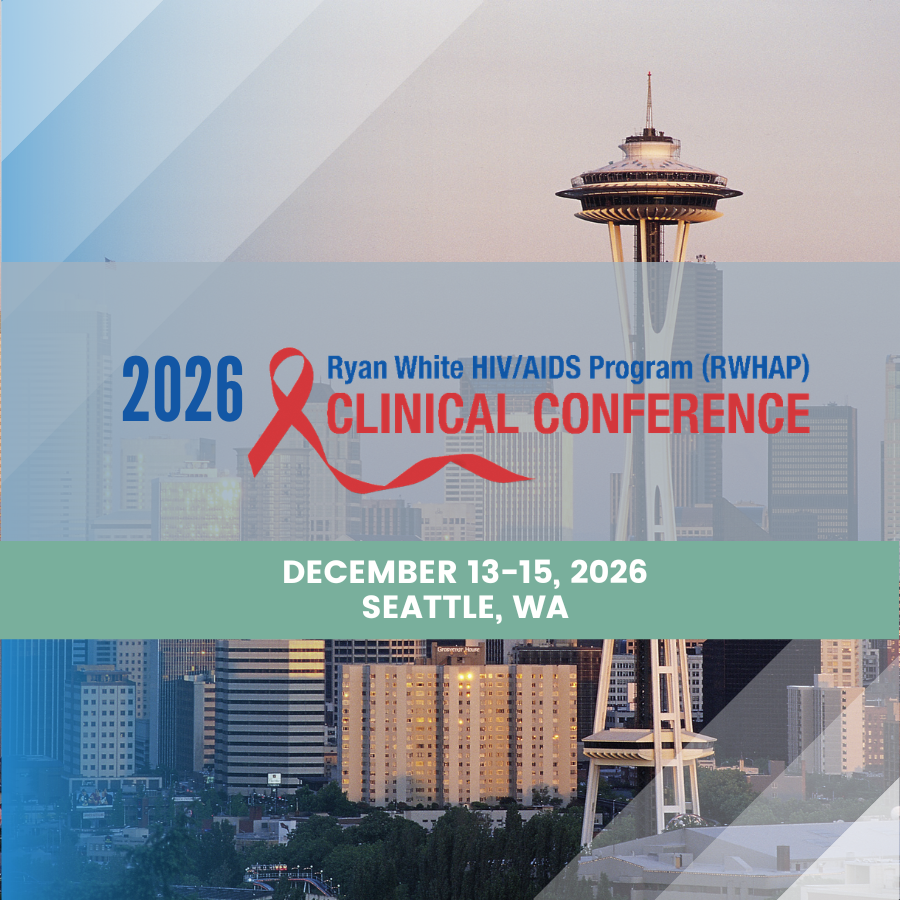
The 2026 Ryan White HIV/AIDS Program (RWHAP) CLINICAL CONFERENCE will be held in-person in Seattle, WA, from Sunday, December 13, to Tuesday, December 15. The RWHAP CLINICAL CONFERENCE will provide state-of-the-art updates on research, care, and treatment issues in the medical management of HIV infection for experienced HIV clinical decision makers.
Serving as co-chairs this year are Britt Gayle, MD, MPH, of the HIV/AIDS Bureau of the Health Resources and Services Administration in Rockville, Maryland; and Michael S. Saag, MD, of the University of Alabama at Birmingham.
The 2026 RWHAP CLINICAL CONFERENCE is planned with and supported by the HIV/AIDS Bureau, Health Resources and Services Administration of the US Department of Health and Human Services (HRSA) and is sponsored and organized by the International Antiviral Society–USA (IAS–USA). This conference is supported through National AETC Support Center clinician training network federal funding.
Participation of clinical decision makers from RWHAP-funded clinics and programs in this educational activity is an integral part of HRSA’s commitment to improving the care and enriching the lives of individuals with HIV. A mix of lectures, case-based interactive presentations, and small-group workshop breakout sessions will be held during the 3 days of the 2026 RWHAP CLINICAL CONFERENCE.
Who Should Attend
Attendance is specifically for HIV clinical decision makers, primarily physicians, nurse practitioners, and physician assistants in Ryan White HIV/AIDS Program (RWHAP)-funded clinics and programs (specifically those operating under parts A, B, C, and D), who are responsible for direct patient care and the decisions on clinical care and practice carried out at their clinics.
For those clinics that do not have clinical decision makers (MD/DOs, PAs, and NPs) or do not have one available at the time to participate, the CLINICAL CONFERENCE offers a limited number of registration spots open specifically for pharmacists and registered nurses who play crucial roles in making clinical decisions within their respective RWHAP-funded clinics or programs.
A key element of the CLINICAL CONFERENCE and integral to HRSA’s commitment to supporting clinicians is that participants from RWHAP-funded clinics or programs are expected to provide relevant updates and training to their clinical colleagues who were unable to attend the conference. Comprehensive resources will be made available to facilitate the development of lectures and educational meetings after the conference.
Each RWHAP-funded clinic (whether through Part A, Part B, Part C, Part D, or a combination of any of these) may register up to 3 eligible staff members to attend.
There is no registration fee to attend.
If you selected to opt in to receive text messages during the registration process, no mobile information will be shared with third parties/affiliates for marketing/promotional purposes.
Preliminary Learning Objectives
The educational objectives for the 2026 RWHAP CLINICAL CONFERENCE are designed and developed based on the identified needs and knowledge gaps of the attendees.
On completion of the 2026 RWHAP CLINICAL CONFERENCE, participants will be able to:
- Describe the new aspects and updates to the Ryan White HIV/AIDS Program
- Identify situations in which the choice of antiretroviral regimen should consider particular clinical circumstances, such as comorbid conditions, coinfections, pregnancy, and issues in older patients
- Describe the most current data on currently available and investigational new antiretroviral drugs, formulations, and strategies
- Initiate and monitor HIV prevention intervention strategies, including the use of long-acting injectable preexposure prophylaxis (PrEP), in individuals at risk for HIV infection
- Describe the current epidemiology, clinical presentations, and management of the most common sexually transmitted infections (STIs) in adults with HIV infection and in special populations such as adolescents
- Implement key primary care practices
- Evaluate and implement evidence-based approaches for the comprehensive care of people with HIV, including the management of common comorbidities and long-term complications
Preliminary Topics
- HRSA Update
- Cases and Panel: Difficult Cases in ART
- Investigational ARVs — What’s on the Horizon
- Functional HIV Cure
- Hepatitis B and Hepatitis D
- Emerging Issues in the Prevention and Management of Sexually Transmitted Infections
- Cases and Panel: Common Issues in Primary Care
- Cardiovascular Disease Prevention After REPRIEVE: Risk Assessment and Lipid Management
- Cases and Panel: Chronic Disease Prevention and Management
- Pulmonary Issues in People with HIV
- Kidney Disease Beyond HIV Nephropathy
- Neurobehavioral Health Update
- Men’s Health
- Oral Health Among People With HIV
- Integration of Technology and Artificial Intelligence in HIV Care
IAS-USA Accreditation Statement
 The International Antiviral Society–USA (IAS–USA) is accredited by the Accreditation Council for Continuing Medical Education (ACCME) to provide continuing medical education for physicians.
The IAS–USA designates this live activity for a maximum of 16.0 AMA PRA Category 1 Credits™. Physicians should claim only the credit commensurate with the extent of their participation in the activity.
ABIM MOC Points
 Successful completion of this CME activity, which includes participation in the evaluation component, enables the participant to earn up to 16.0 MOC points in the American Board of Internal Medicine’s (ABIM) Maintenance of Certification (MOC) program. Participants will earn MOC points equivalent to the amount of CME credits claimed for the activity. IAS-USA, the CME activity provider, will submit your participant information (eg, name, date of birth, activity credits earned, ABIM MOC number) to ABIM through the PARS system for the purpose of reporting ABIM MOC credits.
American Academy of Family Physicians Credits
This activity is eligible for AAFP credit, see final AAFP activity announcement for specific details
Nursing Credits
This activity is eligible for ANCC credit, see final CNE activity announcement for specific details.
Pharmacy Credits
 This activity is eligible for ACPE credit, see final CPE activity announcement for specific details.
Conference Funding
This conference is funded by the Health Resources and Services Administration (HRSA) of the US Department of Health and Human Services (HHS) under grant number U10HA49824.