Introduction
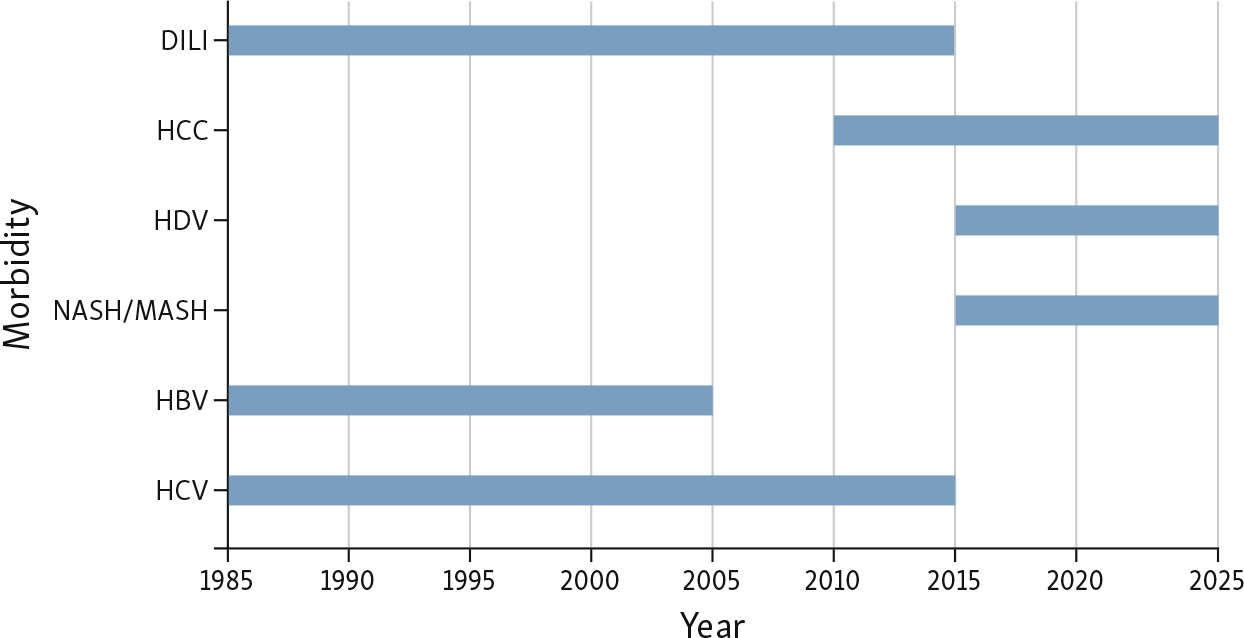
The last 2 decades have witnessed dramatic shifts in mortality among people with HIV (PWH). These changes have occurred against the backdrop of a varied landscape of liver disease processes with specific and unique features. Some of these conditions have been effectively managed, whereas others have only begun to be elucidated by current research. Liver-related diseases continue to cause increased mortality among PWH (see Figure 1).
Figure 1.
Evolving trends in etiology of hepatic disease in HIV. Although all liver disease processes shown have been present throughout the HIV/AIDS epidemic, the years in which they emerged or receded in importance are defined by the blue lines. Drivers of morbidity and mortality have changed over time. HBV and HCV infection dominated for many years, but increased use of HBV-active nucleoside and nucleotide backbones decreased the significance of HBV-associated injury. The arrival of noninterferon-containing direct-acting antiviral regimens for HCV infection led to reductions in morbidity and mortality starting in 2015, while NASH/MASH and HCC increasingly became drivers of liver disease. Early regimens of antiretroviral therapy were often associated with liver injury, but newer regimens in the integrase strand transfer inhibitor era are much safer. Abbreviations: DILI, drug-induced liver injury; HBV, hepatitis B virus; HCC, hepatocellular carcinoma; HCV, hepatitis C virus; HDV, hepatitis D virus; MASH, metabolic-associated steatotic hepatitis; NASH, nonalcoholic steatotic hepatitis.
Infection with hepatitis C virus (HCV) was a dominant cause of progressive liver injury starting in the 1990s, but the infection has been easily cured since 2015.1 However, some people lack access to curative treatment, others may be reinfected, and residual effects include cirrhosis with an ongoing risk of liver cancer.2 Steatotic liver disease has emerged as a new challenge in the general population and among PWH, and perplexing and sometimes conflicting study findings suggest that the underlying etiology of metabolic dysfunction-associated steatotic liver disease (MASLD) represents a challenging and underexplored new frontier. New HIV therapies have emerged that require clinicians to consider whether patients have a background of chronic but suppressed hepatitis B virus (HBV) infection, and failure to do so may lead to profound flares of liver injury, sometimes associated with acute hepatic failure.3 Prevention of hepatitis B through vaccination has been suboptimal in the past among PWH, but new data suggest that the use of CpG adjuvants could have a major impact on future disease.4 New therapies for hepatitis D are on the horizon, but data in PWH are limited, and hepatitis E remains an active and growing issue in some parts of the world but seems to be less important in others.
Since 2006, a biennial meeting, supported by the National Institutes of Health and industry partners, has been held to bring together a diverse group of experts in hepatology, infectious diseases, addiction medicine, epidemiology and public health, and psychiatry to address the myriad issues facing those who treat and manage PWH with concomitant liver disease. In September 2023, key thought leaders, government representatives, and industry stakeholders met at the Ninth Biennial HIV and Liver Disease Conference to determine the current state of the art in this field and to highlight urgent research questions that need to be addressed in the future. This article summarizes the discussions and debates that were held and possible solutions that were identified.
Epidemiology and Natural History of Liver Disease in PWH
The development of liver disease is influenced by a complex interaction between HIV, treatments for HIV, and host (patient) factors. HIV infection is associated with increased gut permeability, systemic immune activation, and in the liver, oxidative stress and the potential for direct activation of stellate cells, resulting in hepatic fibrosis development and progression. Treatment with antiretroviral drugs may lead to direct drug-associated hepatoxicity, deleterious drug-drug interactions, metabolic effects, and the development of immune reconstitution syndromes. The individual may have coinfections (eg, HBV, HCV), obesity, insulin resistance, and other genetic liver disease (eg, hemochromatosis). As PWH are living longer, age is becoming an increasingly important factor in phenotypic presentation of liver disease.5
Global estimates of HCV/HIV coinfection prevalence are around 4 to 5 million. Among PWH, effective treatment with direct-acting antivirals (DAAs) has reduced the incidence of HCV infection and reinfection. Current treatment of HCV infection in PWH is more than 95% effective in viral clearance, and treatment modalities mirror those used among people without HIV. Because of shared routes of transmission, parenteral drug use remains a key factor in the acquisition of HIV and of HCV, which can be reduced with early interventions and needle-exchange programs. HCV is also highly transmissible among men who have sex with men, particularly among anal-receptive individuals with numerous partners. Microepidemics in this group have been reported to be strongly associated with other recreational drug use (“chemsex”).6 The impact of DAA therapies on survival in PWH is not yet known, but US liver transplant statistics demonstrate a decline in overall liver transplant volume associated with HCV infection, with concomitant increases due to steatotic liver disease and alcohol-associated liver disease.7
Most PWH have markers of prior HBV infection, and in the US, it is estimated that 4% to 10% of PWH also have chronic hepatitis B (hepatitis B surface antigen [HBsAg] positive).8 Rates are higher among men who have sex with men than among individuals who inject drugs. Occult HBV infection (HBsAg negative, HBV DNA positive) may be present in up to 10% of PWH, although wide variability is reported across studies.9 The near-universal use of tenofovir as part of combination antiretroviral therapy (ART) regimens for HIV has dramatically improved outcomes typically associated with chronic HBV infection. Nevertheless, Sterling and colleagues10 recently reported that liver biopsies from patients with HBV/HIV coinfection demonstrated advanced fibrosis or cirrhosis in 32% of cases, despite treatment with tenofovir and the presence of normal serum alanine aminotransferase levels. Over the next 4-year period, paired biopsy comparison in a subset of individuals demonstrated that nearly one-third of cases had fibrotic progression, although regression was also observed.12 Recent advances in nucleoside analogue reverse transcriptase inhibitor-sparing oral combination regimens and long-acting therapeutic agents that do not contain tenofovir or other HBV-active agents may result in a resurgence of HBV-associated liver disease. Triple infection with hepatitis D virus (HDV)/HBV/HIV may occur in up to 15% of patients with HBV/HIV coinfection, particularly in parts of Europe, and is associated with a rapid progression to cirrhosis and increased risk of hepatocellular carcinoma (HCC).13
The global prevalence of steatotic liver disease is rising in PWH, but whether this increase is due primarily to traditional risk factors including older age, obesity, and insulin resistance or HIV-associated factors including immune activation and systemic inflammation as well as gut microbial translocation associated with liver injury has been debated.14–16 Given recent concerns about weight gain due to integrase strand transfer inhibitors (InSTIs), an examination of their contribution to steatotic liver disease is needed. Study differences in how steatotic liver disease is assessed (eg, liver biopsy, imaging modalities, and serum fibrosis markers) have contributed to widely varying prevalences in PWH due to reasons such as sample bias in people referred for biopsy and sensitivity of imaging modalities, as summarized by Kalligeros et al (see Table).14
Table.
Global Prevalence of Steatotic Liver Disease in People With HIV by Imaging and Biopsya
| Using noninvasive imaging (ie, TE with CAP, CT, H-MRS, ultrasound) |
| Using liver biopsy |
a From a study of 8230 adult individuals with HIV enrolled from 1999 to 2022, excluding those with viral hepatitis B and C and heavy drinkers.14 Abbreviations: CAP, controlled attenuation parameter; CT, computed tomography; H-MRS, hydrogen-1 magnetic resonance spectroscopy; NAFLD, nonalcoholic fatty liver disease; NASH, nonalcoholic steatohepatitis; TE, transient elastography.
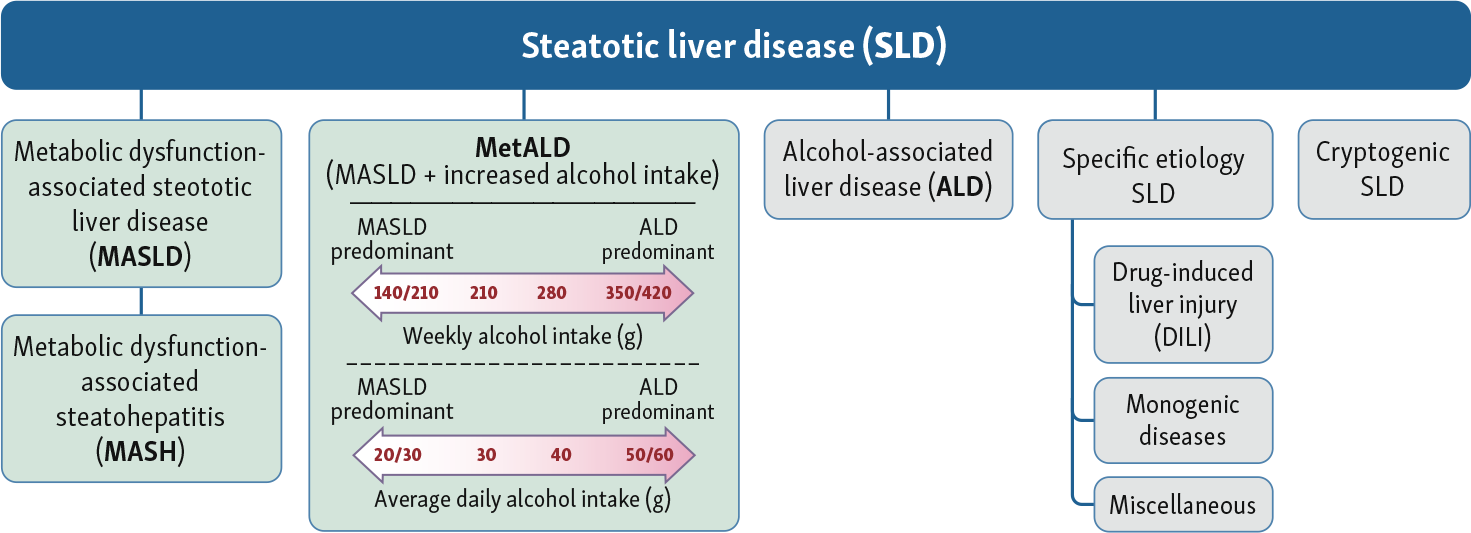
Another recent change is the new nomenclature endorsed by several national society guidelines, with steatotic liver disease now regarded as an umbrella term that includes steatosis due to metabolic dysfunction, alcohol, or both. Because of the exclusion of factors such as excess alcohol use and the use of stigmatizing terminology, nonalcoholic fatty liver disease is now referred to as MASLD (see Figure 2).17
Figure 2.
New classification for steatotic liver disease. Metabolic dysfunction-associated steatotic liver disease (MASLD) is hepatic steatosis plus any feature of metabolic syndrome but no other cause. The term metabolic dysfunction-associated steatohepatitis (MASH) is used when histologic inflammation and ballooning necrosis are present. Several causes can coexist, including metabolic dysfunction and alcohol-associated pathogenesis. Metabolic dysfunction and alcohol-associated liver disease (MetALD) is designated as steatotic liver disease along with an average alcohol intake of 20 to 50 g/day in women and 30 to 60 g/day in men. Other causes of steatotic liver disease are considered separately. Miscellaneous disorders include hepatitis C virus infection, malnutrition, and HIV. According to this updated classification, any individual with liver steatosis and even a single feature of the metabolic syndrome, without excess alcohol intake or other known causes of steatosis, has MASLD. Accordingly, if liver biopsy confirms the presence of nonalcoholic steatohepatitis, the condition is termed MASH and may be accompanied by fibrosis ranging from stage F1 to F4 (with F4 indicating cirrhosis). Adapted with permission from Elsevier.11
HCC is increasing in PWH, but it remains unclear whether this increase is due simply to the aging of patients with advanced fibrosis or cirrhosis or if HIV accelerates HCC incidence. Clearly, PWH have a confluence of risk factors that can be associated with HCC development, including high rates of HBV exposure and chronicity, HCV coinfection, and MASLD or metabolic dysfunction-associated steatohepatitis (MASH) existing in a milieu of altered immune function that may limit T cell-mediated clearance of malignant cells. Sahasrabuddhe et al18 reported a standardized incidence ratio of 3.8 in people with AIDS compared with the general population and an incidence rate of 16.9 cases of HCC per 100,000 person-years in PWH. HIV was not found to be a factor in the development of HCC in a different cohort study, however.19 Once HCC is identified, survival does not appear to differ substantially from that in people without HIV.20 HCC surveillance in individuals at risk appears to be suboptimal, however, and Merchante et al20 noted that appropriate surveillance was achieved in only half of people who should have received twice-yearly ultrasound evaluations. Larger studies that achieve high rates of ongoing surveillance are needed to more accurately define true risk. Definitive treatment of HCC includes liver transplantation in individuals who are acceptable candidates, but worldwide and in the US many centers continue to defer this therapeutic modality in PWH. Recent case series from the US and Europe suggest excellent transplant results, comparable to those in people without HIV.21,22
Evolution of ART and Relationship to Liver Disease
Since the initiation of the effective ART era in 1996, there has been a constant evolution in the availability of new agents and guidance regarding which combinations should be used in different clinical scenarios. Factors driving the changing landscape include the introduction of new medication classes; improved efficacy, tolerability, and safety; availability (in terms of cost and regulatory approval); and patient acceptance and adherence. Hepatic safety and tolerability have been especially important. Early nucleoside analogues including didanosine, zalcitabine, and stavudine are no longer used, in part because of the risk of hepatic mitochondrial toxicity. Indinavir and atazanavir competitively block UDP-glucuronyltransferase, leading to the development of jaundice with unconjugated hyperbilirubinemia, particularly in individuals with Gilbert syndrome. InSTIs have been reported to be associated with weight gain, although the most comprehensive assessments of this association are related primarily to dolutegravir.23 Weight gain is in turn closely linked to development of steatotic liver disease. The newest agents and regimens that are increasingly popular with caregivers and patients include 2-drug regimens that do not contain hepatitis B-active components, leading to risk of hepatitis B recurrence with flare among individuals who previously had viral suppression with regimens containing tenofovir. Injectable combinations such as cabotegravir/rilpivirine that were recently approved by the US Food and Drug Administration have specific contraindications for use in individuals with HBV infection; case reports of hepatitis B flares suggest that appropriate screening is not always performed.24
Mechanisms of Liver Injury in PWH
HIV infection accentuates liver fibrosis caused by viral infection and noninfectious liver disease, and that cooperative interaction is partially reduced when HIV replication is inhibited by ART. Several mechanisms have been described, largely by the Chung laboratory. HCV and HIV induce reactive oxygen species in hepatic stellate cells and hepatocytes. Reactive oxygen species activate the phosphorylation of NF-κB, which upregulate profibrogenic proteins such as transforming growth factor beta 1 (TGF-β1), procollagen alpha 1, and tissue inhibitor of metalloproteinase 1, and suppress antiprofibrogenic proteins such as matrix metalloproteinase 3.25,26 Likewise, a cooperative interaction has been elucidated for HBV and HIV. In various cell lines and in a 3-cell-line trans-well coculture model using macrophages, stellate cells, and hepatocytes, the Chung laboratory has shown that each virus upregulates hypoxia-inducible factor 1 alpha (HIF-1α) and TGF-β1.27 HIV and HBV induce HIF-1α, TGF-β1, and fibrogenesis-related transcripts and proteins.28 HIV engagement increases the net TGF-β1 induction by HBV, and TGF-β1 upregulates HIV-1a via SMAD, which is the primary signal transducer for the TGF beta superfamily of proteins. Inhibition of the process (eg, by interference with HIV-1a via acriflavine) reduces fibrogenesis.
HIV may also increase fibrogenesis by changing the abundance and physiology of liver macrophages. HIV can infect macrophages, and in particular liver-resident Kupffer cells, and deplete Kupffer cells.29 Although HIV cannot replicate fully in Kupffer cells, infection polarizes the cells and appears to be profibrogenic.
HIV infection alone does not appear to increase the risk of MASLD.30 However, as with viral hepatitis, HIV does promote fibrogenesis.31,32 Likewise, with alcohol-related liver disease, HIV increases the risk of clinically significant fibrosis. Several mechanisms are possible, some even with overlap with HCV and HBV given the convergence of fibrogenesis on stellate cells and TGF-β1. The process of enhanced microbial translocation, shared by HIV and alcohol, is a possible mechanism because lipopolysaccharine promotes TGF-β signaling via TLR4.15,33 HIV stimulation of the YAP-TAZ pathway is another possible mechanism promoting liver fibrosis in individuals with steatotic liver disease.34
Treatment and Prevention of Liver Disease
With the rising burden of MASLD in PWH, new pharmacologic treatment options are emerging. Although lifestyle changes such as improved diet and increased physical activity remain a crucial component of the prevention of MASLD and MASH, findings from a recent phase IIb trial in PWH and MASLD showed that low-dose once-weekly semaglutide, a glucagon-like peptide-1 receptor agonist, lowered intrahepatic triglycerides and appeared correlated with reductions in weight, body mass index, and waist circumference, a marker of visceral obesity.35 Although current first-line agents for the treatment of HIV—InSTIs and possibly tenofovir alafenamide (TAF)—have been associated with weight gain, current guidelines do not recommend ART switch in PWH and MASLD to regimens without either of these agents. Other trials are investigating whether statin use reduces the development and progression of MASLD in PWH.
The management of HBV infection in the general population is evolving. Decisions regarding whom and when to treat with nucleotide and nucleoside analogue reverse transcriptase inhibitor-based therapies vary considerably among different expert consensus groups, but there is a trend toward simplification.36 In the setting of concurrent HIV infection, however, guidelines of the US Centers for Disease Control and Prevention and other organizations recommend the use of ART that includes a hepatitis B-active agent, and coformulations generally include tenofovir disoproxil (TDF) or TAF.37,38
Long-term use data support the results of earlier studies indicating that TAF is noninferior in terms of HBV DNA suppression but has fewer renal and bone safety issues than TDF.39–41 In patients with HBV coinfection, HBeAg positive to negative seroconversion may lead to consideration of drug discontinuation in noncirrhotic individuals. This clinical management approach is not recommended in PWH. As noted, case reports have highlighted concerns about HBV reactivation and injury among PWH with previous HBV DNA suppression who are switched to non-HBV-active 2-drug ART regimens.42 HBV status must be evaluated before adopting 2-drug switch strategies. New drugs and combinations that lead to HBV functional cure (HBsAg clearance) are under active investigation, although studies in people coinfected with HBV and HIV are lagging. Promising categories include gene silencing agents (small interfering RNA) and capsid assembly modifiers. A need for combination therapies to optimize response rates seems likely.41
HDV infection occurs with increased frequency among PWH, as a superinfection or coinfection. Screening strategies are suboptimal and underutilized. Optimal screening and surveillance require testing for HDV antibody with a reflex to HDV RNA testing. In most series, HDV RNA is present in less than 50% of overall individuals who are antibody positive. The overall prevalence of HDV infection remains controversial because of limited testing and minimal use of HDV RNA reflex testing, but HDV infection seems moderately prevalent in European HIV cohorts. When infection is present, it is strongly associated with increased rates of fibrotic progression to cirrhosis and higher risk of developing HCC.13 Treatment options for HDV infection are available in Europe and are under US Food and Drug Administration review. There are limited data suggesting good efficacy of bulevirtide, a drug that binds to NTCP (sodium taurocholate cotransporter protein), with or without peginterferon alfa administration.42 Although studies with lonafarnib showed promise, development has been halted.
Because HCV infection can be cured by DAAs in nearly all individuals, including PWH, consideration of HCV treatment now pivots on treatment access and posttreatment outcomes. Where access to HCV treatment is high, nearly all PWH and hepatitis C have been cured.43 However, even in the communities where very high cure rates are found among PWH sustained in care, many other individuals remain outside of care and untreated.44 HCV reinfection is another challenge to efforts to eliminate HCV infection in PWH despite the high efficacy of DAA treatment.45
In people with cirrhosis who are cured, there is a substantial reduction in liver decompensation, liver cancer, and mortality. Corresponding reductions in liver fibrosis occur in people with HCV who are cured before cirrhosis is detected. Clinical improvements are also evident in most so-called extrahepatic diseases associated with HCV infection.46 Because only a fraction of these extrahepatic conditions are caused by HCV infection, it is logical that some but not all improve when cured. For example, after cure most individuals with HCV-related cryoglobulin vasculitis have improvements in symptoms.47 However, in some people the vasculitis may persist even after cure.48 Improvements have also been documented by cure of hepatitis C in porphyria cutanea tarda, and to a lesser extent, lichen planus.49 It has been more difficult to disentangle the contribution of HCV infection to diabetes and heart disease and the corresponding benefits of treatment.
Research Agenda and Conclusion
Recent years have witnessed great advances in the management of liver disease among individuals with HIV. Hepatitis C, which dominated the research agenda for decades, is now easily cured with safe oral medications. For patients receiving HIV treatment, HCV infection cure is the rule rather than the exception. However, a large portion of the population has advanced hepatic fibrosis, and barriers remain to adequate screening and management of HCC. For individuals who are not actively in HIV care settings, coinfection with HCV remains common, and improved efforts are needed to reach undiagnosed and untreated patients who fall out of the current care system. To this end, targeted demonstration projects that address barriers to care among incarcerated and unhoused populations are needed. Studies indicate that multidisciplinary care can improve outcomes, but economic models that drive policy are still lacking. Hepatitis B and D therapies are on the verge of major breakthroughs, but the inclusion of PWH is crucial as studies enter phase II and III designs. Prevention strategies are evolving. New data suggest that CpG-based HBV vaccination yields higher response rates, but the underlying mechanisms of vaccine failure remain to be fully elucidated. Steatotic liver disease has become increasingly recognized as an issue in PWH, but so far clinical trials have largely excluded those participants from enrollment. Not surprisingly, glucagon-like peptide-1 agents can lead to weight loss, decreased alanine aminotransferase level, and improved steatosis with imaging, but some data suggest that underlying mechanisms of steatotic liver disease may not mirror that seen in the general population. Basic and translational research as well as inclusive drug trials are needed.
The research agenda for the next several years remains robust in the area of HIV and liver disease. Liver disease continues to be a major contributor to morbidity and mortality in PWH, and ongoing investment in investigating mechanisms and possible interventions is crucial.
Acknowledgments
Funding for the Ninth Biennial HIV and Liver Disease Conference was provided (in part) by the National Institutes of Health under Award Number R13AI071925 from the National Institute of Allergy and Infectious Diseases (NIAID). The views expressed in this article by the authors do not necessarily reflect the official policies of the US Department of Health and Human Services; nor does mention of trade names, commercial practices, or organizations imply endorsement by the US Government. The conference was also supported by educational grants from Abbott Laboratories, Gilead Sciences, Inc, Theratechnologies Inc, Vir Biotechnology, and ViiV Healthcare.
Notes
The IAS-USA will identify and resolve ahead of time any possible conflicts of interest that may influence continuing medical education (CME) activities with regard to exposition or conclusion. All financial relationships with ineligible companies for the authors and planners/reviewers are listed below.
Financial affiliations with ineligible companies in the past 24 months: Dr Sherman reported receiving grant support or contracts awarded to his institution from AbbVie, Gilead Sciences, Inc, Intercept Pharmaceuticals, Inc, Zydus, and Helio. He reported serving on data and safety monitoring boards for Medpace Inc., Pliant, and Horizon/AMGEN. (Updated February 4, 2025) Dr Tien reported receiving grant support awarded to her institution from Merck. (Updated February 4, 2025) Dr Thomas reported consulting or advising fees from Excision Bio; and fees for participation in review activities from Merck. (Updated February 4, 2025)
References
[1.] S Schlabe, JK Rockstroh. Advances in the treatment of HIV/HCV coinfection in adults. Expert Opin Pharmacother. 2018;19(1): 49–64. doi:10.1080/14656566.2017.1419185
[2.] D Ortiz-Paredes, A Amoako, D Lessard, K Engler, B Lebouche, MB Klein. Barriers and facilitators related to HCV treatment uptake among HIV coinfected populations in Canada: patient and treatment provider perceptions. Can Liver J. 2022;5(2): 124–143. doi:10.3138/can-livj-2021-0020
[3.] S Moreno, CF Perno, PW Mallon, et al. Two-drug vs three-drug combinations for HIV-1: do we have enough data to make the switch? HIV Med. 2019;20(Suppl 4): 2–12. doi:10.1111/hiv.12716
[4.] KM Marks, M Kang, T Umbleja, et al. Immunogenicity and safety of hepatitis B virus (HBV) vaccine with a tolllike receptor 9 agonist adjuvant in HBV vaccine-naive people with human immunodeficiency virus. Clin Infect Dis. 2023;77(3): 414–418. doi:10.1093/cid/ciad201
[5.] AW Chan, YA Patel, S Choi. Aging of the liver: what this means for patients with HIV. Curr HIV/AIDS Rep. 2016;13(6): 309–317. doi:10.1007/s11904-016-0332-x
[6.] JM Carson, S Barbieri, E Cunningham, et al. Sexual and drug use risk behaviour trajectories among people treated for recent HCV infection: the REACT study. J Int AIDS Soc. 2023;26(9): e26168. doi:10.1002/jia2.26168
[7.] A Shingina, PE DeWitt, JL Dodge, et al. Future trends in demand for liver transplant: birth cohort effects among patients with NASH and HCC. Transplantation. 2019;103(1): 140–148. doi:10.1097/TP.0000000000002497
[8.] PR Spradling, JT Richardson, K Buchacz, AC Moorman, JT Brooks. Prevalence of chronic hepatitis B virus infection among patients in the HIV Outpatient Study, 1996–2007. J Viral Hepat. 2010;17(12): 879–886. doi:10.1111/j.1365-2893.2009.01249.x
[9.] M Pisaturo, L Onorato, A Russo, P Chiodini, N Coppola. An estimation of the prevalence of occult HBV infection in Western Europe and in Northern America: a meta-analysis. J Viral Hepat. 2020;27(4): 415–427. doi:10.1111/jvh.13248
[10.] RK Sterling, AS Wahed, WC King, et al. Spectrum of liver disease in hepatitis B virus (HBV) patients co-infected with human immunodeficiency virus (HIV): results of the HBV-HIV cohort study. Am J Gastroenterol. 2019;114(5): 746–757. doi:10.1038/s41395-018-0409-9
[11.] S Qadri, H Yki-Jarvinen. Surveillance of the liver in type 2 diabetes: important but unfeasible? Diabetologia. 2024;67(6): 961–973. doi:10.1007/s00125-024-06087-7
[12.] RK Sterling, WC King, M Khalili, et al. A prospective study evaluating changes in histology, clinical and virologic outcomes in HBV-HIV co-infected adults in North America. Hepatology. 2021;74(3): 1174–1189. doi:10.1002/hep.31823
[13.] DW Yen, V Soriano, P Barreiro, KE Sherman. Triple threat: HDV, HBV, HIV coinfection. Clin Liver Dis. 2023;27(4): 955–972. doi:10.1016/j.cld.2023.05.010
[14.] M Kalligeros, A Vassilopoulos, S Vassilopoulos, DW Victor, E Mylonakis, M Noureddin. Prevalence of steatotic liver disease (MASLD, MetALD, and ALD) in the United States: NHANES 2017–2020. Clin Gastroenterol Hepatol. 2024;22(6): 1330–1332. doi:10.1016/j.cgh.2023.11.003
[15.] MJ Duarte, PC Tien, A Kardashian, et al. Microbial translocation and gut damage are associated with an elevated fast score in women living with and without HIV. Open Forum Infect Dis. 2024;11(5): ofae187. doi:10.1093/ofid/ofae187
[16.] J Price, Y Ma, A Adimora, et al. Multisite prospective liver disease and reproductive ageing (LIVRA) study in US women living with and without HIV. BMJ Open. 2022;12(4): e055706. doi:10.1136/bmjopen-2021-055706
[17.] ME Rinella, JV Lazarus, V Ratziu, et al. A multi-society Delphi consensus statement on new fatty liver disease nomenclature. Hepatology. 2023;78(6): 1966–1986. doi:10.1097/HEP.0000000000000520
[18.] VV Sahasrabuddhe, MS Shiels, KA McGlynn, EA Engels. The risk of hepatocellular carcinoma among individuals with acquired immunodeficiency syndrome in the United States. Cancer. 2012;118(24): 6226–6233. doi:10.1002/cncr.27694
[19.] DJ Pinato, E Allara, TY Chen, et al. Influence of HIV infection on the natural history of hepatocellular carcinoma: results from a global multicohort study. J Clin Oncol. 2019;37(4): 296–304. doi:10.1200/JCO.18.00885
[20.] N Merchante, M Rodriguez-Fernandez, B Figueruela, et al. Impact of HIV on the survival of hepatocellular carcinoma in hepatitis C virus-infected patients. AIDS. 2020;34(10): 1497–1507. doi:10.1097/QAD.0000000000002578
[21.] A Zarinsefat, A Gulati, A Shui, et al. Long-term outcomes following kidney and liver transplant in recipients with HIV. JAMA Surg. 2022;157(3): 240–247. doi:10.1001/jamasurg.2021.6798
[22.] GP Guerrini, M Berretta, G Guaraldi, et al. Liver transplantation for HCC in HIV-infected patients: long-term single-center experience. Cancers (Basel). 2021;13(18). doi:10.3390/cancers13184727
[23.] AR Eckard, GA McComsey. Weight gain and integrase inhibitors. Curr Opin Infect Dis. 2020;33(1): 10–19. doi:10.1097/QCO.0000000000000616
[24.] C Pintado, C Delaugerre, JM Molina. Acute hepatitis B infection after a switch to long-acting cabotegravir and rilpivirine. Open Forum Infect Dis. 2020;7(9): ofaa367. doi:10.1093/ofid/ofaa367
[25.] S Salloum, JA Holmes, R Jindal, et al. Exposure to human immunodeficiency virus/hepatitis C virus in hepatic and stellate cell lines reveals cooperative profibrotic transcriptional activation between viruses and cell types. Hepatology. 2016;64(6): 1951–1968. doi:10.1002/hep.28766
[26.] W Lin, EM Weinberg, RT Chung. Pathogenesis of accelerated fibrosis in HIV/HCV co-infection. J Infect Dis. 2013;207(Suppl 1): S13–S18. doi:10.1093/infdis/jis926
[27.] PAC Wing, PJ Liu, JM Harris, et al. Hypoxia inducible factors regulate hepatitis B virus replication by activating the basal core promoter. J Hepatol. 2021;75(1): 64–73. doi:10.1016/j.jhep.2020.12.034
[28.] M Xu, C Warner, X Duan, et al. HIV coinfection exacerbates HBV-induced liver fibrogenesis through a HIF-1alpha- and TGF-beta1-dependent pathway. J Hepatol. 2024;80(6): 868–881. doi:10.1016/j.jhep.2024.01.026
[29.] A Balagopal, SC Ray, RM de Oca, et al. Kupffer cells are depleted with HIV immunodeficiency and partially recovered with antiretroviral immune reconstitution. AIDS. 2009;23(18): 2397–2404. doi:10.1097/QAD.0b013e3283324344
[30.] DM Kirkegaard-Klitbo, A Fuchs, S Stender, et al. Prevalence and risk factors of moderate-to-severe hepatic steatosis in human immunodeficiency virus infection: the Copenhagen co-morbidity liver study. J Infect Dis. 2020;222(8): 1353–1362. doi:10.1093/infdis/jiaa246
[31.] JC Price, Y Ma, MH Kuniholm, et al. Human immunodeficiency virus is associated with elevated fibroScan-aspartate aminotransferase (FAST) score. Clin Infect Dis. 2022;75(12): 2119–2127. doi:10.1093/cid/ciac337
[33.] A Balagopal, FH Philp, J Astemborski, et al. Human immunodeficiency virus-related microbial translocation and progression of hepatitis C. Gastroenterology. 2008;135(1): 226–233. doi:10.1053/j.gastro.2008.03.022
[34.] X Wang, Z Zheng, JM Caviglia, et al. Hepatocyte TAZ/WWTR1 promotes inflammation and fibrosis in Nonalcoholic steatohepatitis. Cell Metab. 2016;24(6): 848–862. doi:10.1016/j.cmet.2016.09.016
[35.] JE Lake, DW Kitch, A Kantor, et al. The effect of open-label semaglutide on metabolic dysfunction-associated steatotic liver disease in people with HIV. Ann Intern Med. 2024;177(6): 835–838. doi:10.7326/M23-3354
[36.] D Dieterich, C Graham, S Wang, et al. It is time for a simplified approach to hepatitis B elimination. Gastro Hep Adv. 2023;2(2): 209–218. doi:10.1016/j.gastha.2022.10.004
[37.] MS Saag, RT Gandhi, PE Sax. Antiretroviral drug recommendations for HIV treatment and prevention-reply. JAMA. 2021;325(9): 889–890. doi:10.1001/jama.2020.25990
[38.] RT Gandhi, R Bedimo, JF Hoy, et al. Antiretroviral drugs for treatment and prevention of HIV infection in adults: 2022 recommendations of the International Antiviral Society-USA Panel. JAMA. 2023;329(1): 63–84. doi:10.1001/jama.2022.22246
[39.] K Agarwal, M Brunetto, WK Seto, et al. 96 weeks treatment of tenofovir alafenamide vs tenofovir disoproxil fumarate for hepatitis B virus infection. J Hepatol. 2018;68(4): 672–681. doi:10.1016/j.jhep.2017.11.039
[40.] S Vasishta, D Dieterich, M Mullen, J Aberg. Brief report: hepatitis B infection or reactivation after switch to 2-drug antiretroviral therapy: a case series, literature review, and management discussion. J Acquir Immune Defic Syndr. 2023;94(2): 160–164. doi:10.1097/QAI.0000000000003239
[41.] H Gopalakrishna, MG Ghany. Perspective on emerging therapies to achieve functional cure of chronic hepatitis B. Curr Hepatol Rep. 2024;23(2): 241–252. doi:10.1007/s11901-024-00652-9
[42.] V de Lédinghen, C Fougerou-Leurent, E Le Pabic, et al. Treatment with bulevirtide in HIV-infected patients with chronic hepatitis D: ANRS HD EP01 BuleDelta and compassionate cohort. JHEP Rep. 2024;6(8): 101057. doi:10.1016/j.jhepr.2024.101057
[43.] O Falade-Nwulia, CR Lesko, AT Fojo, et al. Hepatitis C treatment in people with HIV: potential to eliminate disease and disparity. J Infect Dis. 2024;229(3): 775–779. doi:10.1093/infdis/jiad433
[44.] JA Cepeda, DL Thomas, J Astemborski, et al. Impact of hepatitis C treatment uptake on cirrhosis and mortality in persons who inject drugs: a longitudinal, community-based cohort study. Ann Intern Med. 2022;175(8): 1083–1091. doi:10.7326/M21-3846
[45.] S Amele, AK Sandri, A Rodger, et al. HCV reinfection after HCV therapy among HIV/HCV-coinfected individuals in Europe. HIV Med. 2022;23(6): 684–692. doi:10.1111/hiv.13212
[46.] P Cacoub, AC Desbois, C Comarmond, D Saadoun. Impact of sustained virological response on the extrahepatic manifestations of chronic hepatitis C: a meta-analysis. Gut. 2018;67(11): 2025–2034. doi:10.1136/gutjnl-2018-316234
[47.] L Gragnani, M Visentini, E Fognani, et al. Prospective study of guideline-tailored therapy with direct-acting antivirals for hepatitis C virus-associated mixed cryoglobulinemia. Hepatology. 2016;64(5): 1473–1482. doi:10.1002/hep.28753
[48.] M Bonacci, S Lens, Z Marino, et al. Long-term outcomes of patients with HCV-associated cryoglobulin-emic vasculitis after virologic cure. Gastroenterology. 2018;155(2): 311–315. doi:10.1053/j.gastro.2018.04.024
[49.] LJ Garcia-Fraile, L Garcia-Buey, CC Alonso, SJ Sanz, I de Los Santos Gil. Evolution of HCV associated porphyria cutanea tarda after HCV sustained virologic response by direct acting antivirals. Gastroenterol Hepatol. 2022;45(4): 249–255. doi:10.1016/j.gastrohep.2021.09.001